


Grocery Prices Keep Climbing. Why Are Rotisserie Chickens Still So Cheap?
Grocery Prices Keep Climbing. Why Are Rotisserie Chickens Still So Cheap?
0
Share

Laura KinirySat, November 28, 2026 at 11:00 AM UTC
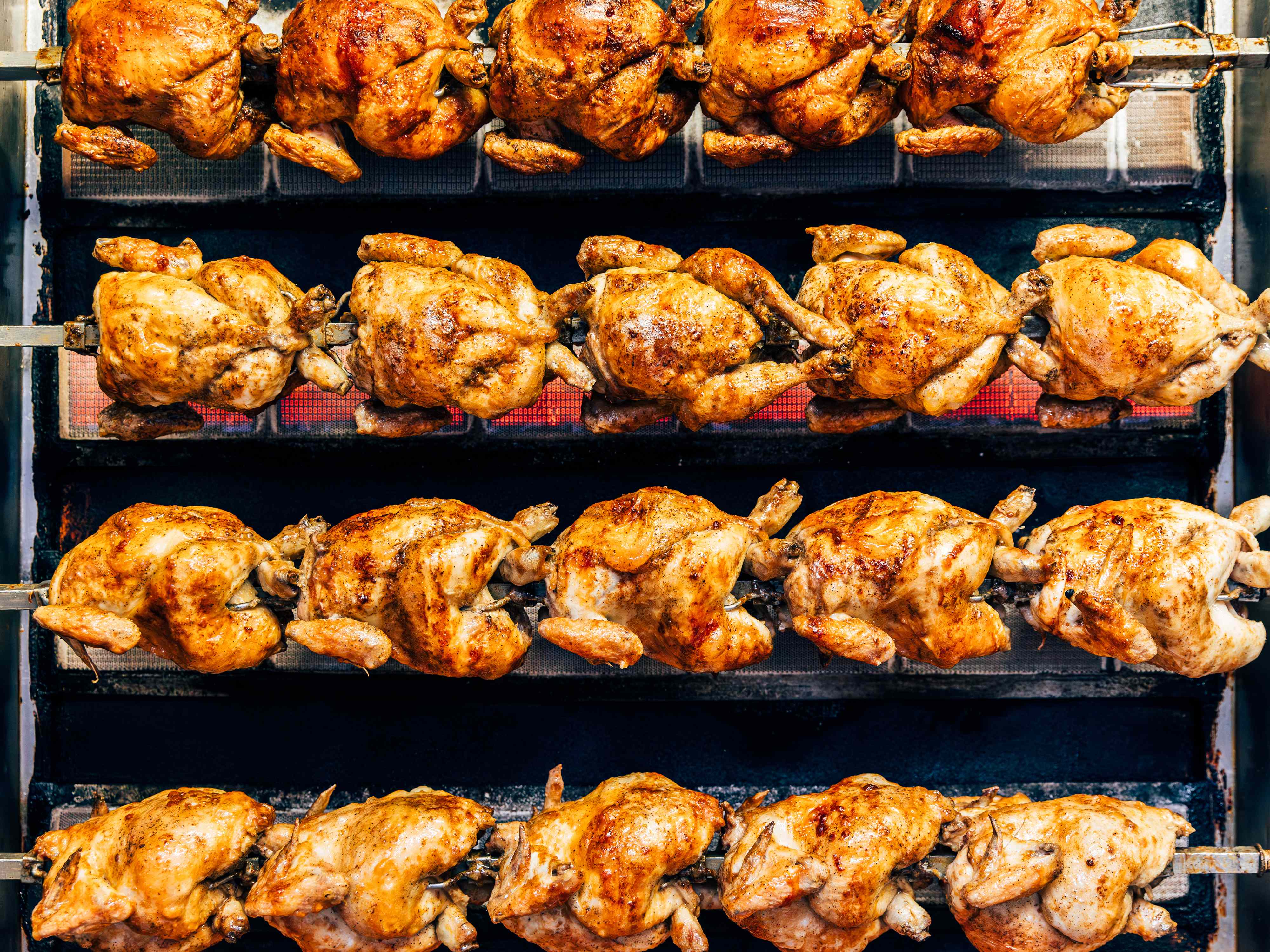
Credit: Getty Images /Alexander SpatariIn a Nutshell
Rotisserie chicken remains one of the cheapest items in the grocery store—not because it’s inexpensive to produce, but because retailers deliberately price it that way. Stores use the $4.99 bird as a “loss leader” to draw shoppers inside, where they’re likely to spend more on higher-margin items. That strategy works thanks to decades of industrial efficiency in the poultry industry, from selective breeding to vertical integration. The result is a hot, ready-to-eat chicken that feels like a bargain—because it’s carefully engineered to be one.
Walk past the deli counter of almost any American grocery store and you’ll see it: a golden-brown rotisserie chicken still hovering stubbornly around $4.99—even as the prices of eggs, beef, and just about everything else have climbed. At Costco, it has cost $4.99 for more than a decade. Walmart sells one for $5.97. Whole Foods discounts its chickens for Prime members on Tuesdays, sometimes knocking a few dollars off birds that start under $10.
In an era of inflation, it feels almost defiant. How can a fully cooked, hot, ready-to-eat chicken cost less than many raw ones? The answer isn’t mystery preservatives or “fake” poultry. It’s a deliberate business strategy.
The $4.99 Chicken as Retail Strategy
Traditionally, Tuesdays aren’t the busiest day of the week for grocery stores. At Whole Foods, though, Tuesdays are when rotisserie chickens practically fly out of the store. That’s because Prime members can typically get the store’s classic and organic rotisserie chickens for $2 off their usual price.
Those chicken deals bring customers in who are likely to pick up other items while they’re there. “We definitely see rotisserie chicken as a trip driver,” says Whole Foods Market Prepared Foods Category Merchant Luke Meinzer, who oversees the company’s rotisserie chicken program.” One San Francisco Whole Foods employee said their customers “are just so passionate about our rotisserie chicken” that one customer tracked down a store manager, then figured out who that person’s boss is, and “figured out who the store manager was then sent them an email saying that “they need to make more chickens.”
They’re not alone. At $5.97, Walmart’s Freshness Guaranteed rotisserie chicken is one of the store’s most popular items, according to a company spokesperson. The retailer also sells a rotisserie meal bundle that includes a freshly roasted chicken and two hot sides for under $10. And at Costco, a rotisserie chicken goes for $4.99 per bird.
“Costco is one of the more prominent plays in the front of folks’ minds when they think about rotisserie chicken,” says Brian Earnest, the lead animal protein economist for CoBank, a private provider of credit to US rural economy, “because famously you go into a Costco and try and get a $5 rotisserie chicken and end up spending, you know, $100 or $200 in the store.”
In fact, Costco recently revealed to its shareholders that it sold 157.4 million rotisserie chickens worldwide in 2025—nearly 300 birds a minute.
That volume isn’t incidental. Costco and other retailers sell rotisserie chickens for $4.99 each and use them as what’s known as a loss leader—a product sold below market cost, sometimes at a loss, to draw customers into the store. Once inside, shoppers are likely to purchase additional items to round out a meal, whether bagged salad, wine, or pantry staples. Retailers may lose money on the chicken itself, but they often make up the difference on higher-margin items in the same basket.
According to Hoa Hoang, an expert on food prices for the Food and Agricultural Policy Research Institute (FAPRI) at the University of Missouri, grocery stores use this strategy for several reasons.
First, retailers want to remain competitive. If other stores offer discounted rotisserie chickens, it makes sense from a business standpoint to do the same. The low price also “gives customers a sense of assurance,” Hoang says, reinforcing the perception that the store offers good value overall.
Rotisserie chickens are particularly well suited to this approach because businesses “can make them in large quantities,” spreading fixed costs such as machinery, seasoning, packaging, and labor over a high volume. “We call it economies of scale,” she says. In short, it’s cheaper to produce a large quantity of something than a small one.
For example, a store might contract with a supplier to provide pre-seasoned birds in bulk. The poultry arrives, is placed on the rotisserie to cook, and is then bagged and labeled when ready. High output keeps per-unit costs down. Some stores also repurpose unsold rotisserie meat in deli items such as soups or pot pies, minimizing waste and protecting margins.
But retail strategy alone doesn’t explain how a fully cooked chicken can sell for less than many raw ones. For that, you have to look further up the supply chain.
How Industrial Efficiency Makes It Possible
Whole chickens are uniquely suited to industrial efficiency. Scale, breed selection, and processing methods drive costs down in ways home cooks rarely see.
Advertisement
The industrial broiler industry—the breeding, raising, and processing of chickens for meat—expanded rapidly during World War II, when the U.S. government implemented strict red meat rationing to ensure a steady supply for armed forces. A national campaign encouraged Americans to eat more poultry instead. As demand grew, industrial broiler breeding became the norm.
Over time, the poultry industry selectively bred chickens for traits that maximize production efficiency, such as faster growth, higher breast-meat yield, and improved feed conversion.
Today, most commercial rotisserie chickens are Cornish Cross hybrids with a high breast-meat-to-bone ratio. They are typically processed between six and 12 weeks old; for example, Costco’s Kirkland Signature birds are raised for 42 to 43 days (about six weeks).
The industry is also highly consolidated. “It’s owned by a few companies,” including Tyson and Perdue, says Hoang. “So this way they can control the quality, breeds, consistency, and the type of meat that you want. This also helps reduce the cost.”
That level of consolidation and vertical integration allows companies to control breeding, feed, processing, and distribution—lowering per-bird costs through standardization and scale.
However, maximizing efficiency has raised concerns from within the poultry industry and from animal wellfare advocates. Rapid growth rates have been linked to health issues in chickens, including neuromuscular disorders and heart problems. “The fastest growing strains had disproportionate heart and lung development, which may negatively influence their cardiopulmonary functioning,” according to a report from Global Animal Partnership.
“Animal welfare is a topic that I don’t have a whole lot of visibility into,” says Earnest. However, “better welfare and flock management practices produce better meat quality, so there’s a fine balance of maintaining the health of the flock while also continuing to improve our efficiencies at the same time.”
The Psychology of a Deal
If industrial efficiency makes low prices possible, consumer psychology helps make them powerful.
Scott Rick, an associate professor of marketing at the University of Michigan, points to research in “mental accounting”—the way consumers evaluate value in relative terms.
“In the ‘mental accounting’ literature,” he says, “there’s a classic story about a person encountering different-sized comforters all at the same low price. They bought a king-size comforter, despite having a queen-size bed, just because the king-size comforter was the best deal available.”
The same logic applies to rotisserie chickens. At $4.99, they become a benchmark. As noted earlier, even if a store earns little on the chicken itself, the price anchors shoppers’ perception of value throughout the store.
For many home cooks, the appeal is both practical and psychological. Store-bought rotisserie chickens are easy, versatile, and ready to eat. Compared with buying a raw chicken, seasoning it, and cooking it at home, the prepared version often feels cheaper and more convenient.
Store-Bought vs. Roasting at Home
There are differences, however. Grocery store rotisserie chickens are often saltier and have a distinct texture due to large-scale seasoning and cooking processes: A commercial rotisserie’s constant rotation over steady heat helps distribute juices evenly and crisp the skin without burning, resulting in a consistent golden-brown sheen. On the other hand, roasting a chicken at home allows total quality control from bird selection to seasoning to cooking temperature.
Ultimately, whether or not to purchase a store rotisserie chicken is a personal choice. But as long as shoppers continue to see it as a bargain—and keep adding other items to their carts — the pricing strategy is likely to stick. “If a store’s strategy wasn’t working,” says Hoang, “then they’d probably just stop selling it.”
on Serious Eats
Source: “AOL Money”
